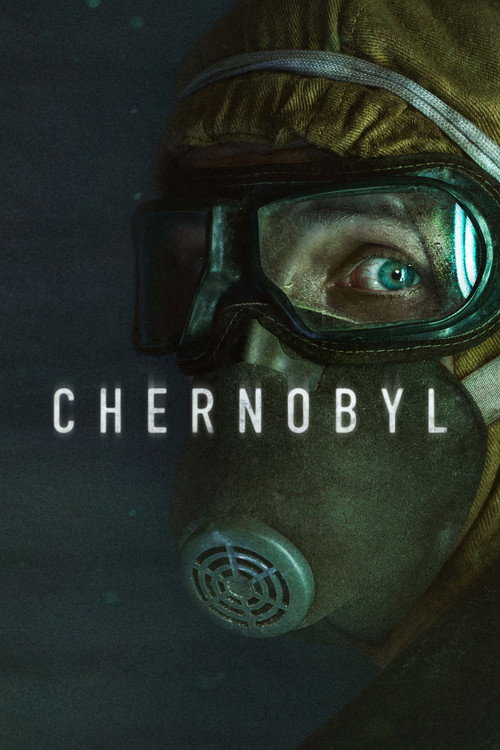
Chernobyl (2019)
Add to watchlistAt a glance
| Created by | Craig Mazin |
|---|---|
| Genre | Drama |
| Release date | 2019-05-06 |
| Age rating | 14+ |
| TMDB rating | 8.7 (8,583 votes) |
Trailer
Playing loads the video from YouTube (Google), which receives your IP address.
What it is about
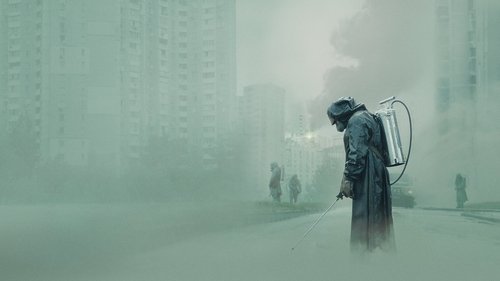
In the night of 26 April 1986, reactor block 4 at the Chernobyl nuclear power plant explodes. The five-part series begins two years later with the suicide of physicist Valery Legasov and tells the story backwards from there.
It follows three levels: the people on the ground — firefighters extinguishing the blaze without knowledge of radiation, workers and miners driving a tunnel beneath the reactor — the scientists calculating what could still happen, and the apparatus that initially denies every one of these findings. The final episode reconstructs as a court hearing what actually occurred during the night of the accident.
How it came about
Craig Mazin began his research in 2014: books, government reports, conversations with nuclear physicists and with people who had lived in the Soviet Union. One of the most important sources is Svetlana Alexievich's "Chernobyl: A Chronicle of the Future", a book compiled from witness accounts.
One character is invented: physicist Ulana Khomyuk stands in for the many scientists involved in uncovering what happened. Mazin disclosed this and justified it by explaining that he needed to keep the number of characters manageable.
Behind the scenes
Filming took place in Lithuania and in Kyiv. The district of Fabijoniškės in Vilnius stood in for Pripyat, the decommissioned Ignalina nuclear power plant — identical in design to Chernobyl — for the facility itself.
The production design was widely praised for its accuracy, down to wallpaper, clothing and packaging. The music was composed by Hildur Guðnadóttir from recordings she made in a decommissioned power plant — not instruments, but the sounds of the facility itself, processed into a continuous soundscape.
Context and impact
The series received approximately ninety-five per cent positive reviews and won ten Emmy awards, including for outstanding limited series.
The reactions were not uniform everywhere. Russian state media called it propaganda; in Ukraine and Belarus reception was predominantly positive. Professionally, some simplifications were criticised, such as the depiction of radiation as transmissible. A measurable side effect was the increase in guided tours to the exclusion zone of Pripyat, which rose noticeably after broadcast.
Images



Cast & crew
- Jared Harris as Valery Legasov
- Stellan Skarsgård as Boris Shcherbina
- Emily Watson as Ulana Khomyuk
- Paul Ritter as Anatoly Dyatlov
- Jessie Buckley as Lyudmilla Ignatenko
- Adam Nagaitis as Vasily Ignatenko
- Sam Troughton as Alexandr Akimov
- Robert Emms as Leonid Toptunov
- Con O'Neill as Viktor Bryukhanov
- Adrian Rawlins as Nikolai Fomin
Similar titles



Availability
Not currently included in any known streaming subscription.